
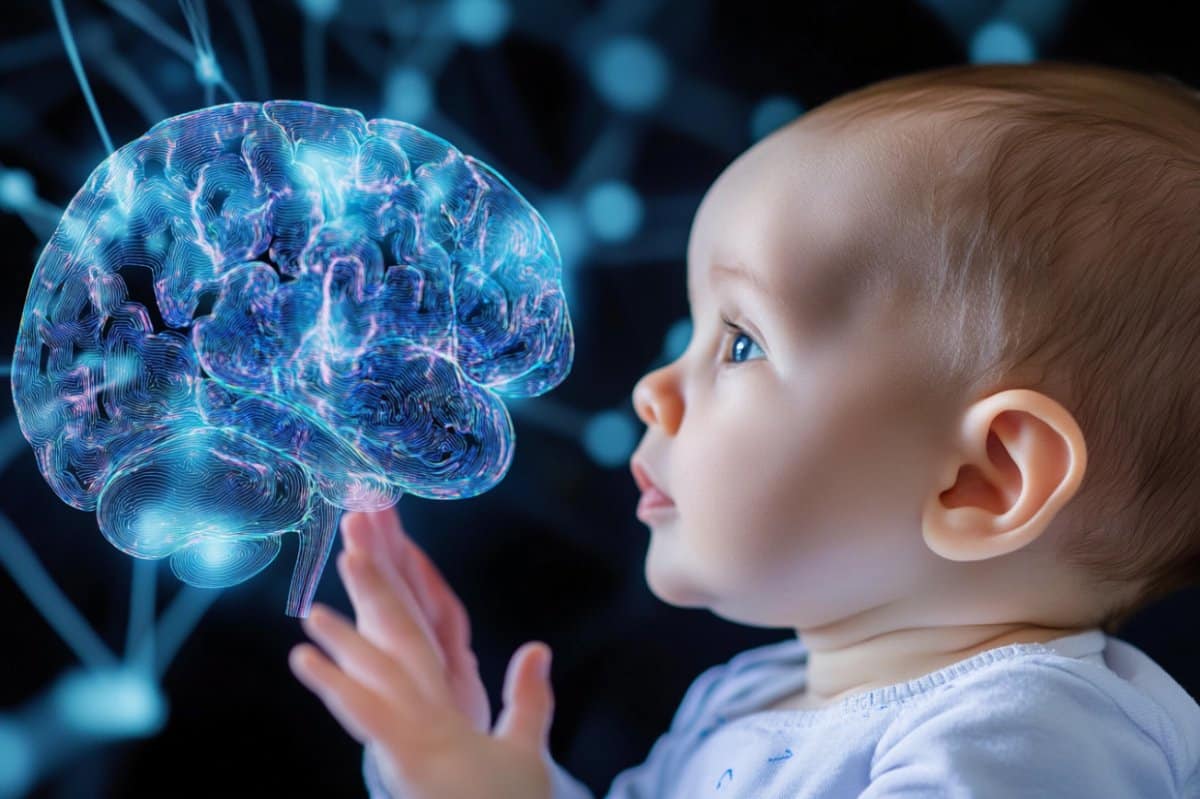
Early neurodevelopment research focuses on how the human brain, behavior and environment interact during infancy and early childhood. The field does not try to predict a child’s future development with certainty. Instead, it studies patterns across groups of children to understand how development normally varies.
The historical research direction associated with the former Eurosibs consortium (European infant sibling autism research network) contributed to building large observational datasets of infant development. The project was part of broader European biomedical research collaborations including the EU-AIMS (European autism research consortium) programme and its successor initiative, AIMS-2-TRIALS (European autism translational research initiative).
These initiatives focused on understanding developmental mechanisms rather than creating early diagnostic tests for individual children.
What does early neurodevelopment research actually study?
Neurodevelopment research examines how children acquire cognitive, social and motor abilities over time. Scientists are interested in developmental trajectories rather than single observations.
Three major domains are usually studied.
- Social communication development
- Language and auditory processing
- Motor coordination and exploration behavior
Researchers compare groups of children to understand statistical differences in developmental patterns. Individual variation is considered normal and expected.
Development is a spectrum, not a binary state
Modern neuroscience increasingly treats cognitive and behavioral traits as continuous distributions rather than strict categories.
For example, attention to social stimuli varies naturally among typically developing children. Lower or higher response levels do not automatically indicate clinical conditions.
The goal of developmental science is to identify mechanisms that support healthy learning and communication rather than labeling children early.
Why sibling cohort research became important
One widely used design in developmental science is the high-risk cohort model. This approach studies children who have an older sibling diagnosed with autism spectrum disorder.
Statistical studies show that children in sibling cohorts have elevated likelihood of receiving the same diagnosis compared to the general population. However, this relationship is probabilistic.
Risk at population level does not mean outcome prediction at individual level.
The research network associated with the historical Eurosibs consortium (European infant sibling autism research network) helped standardize measurement methods across European research centers.
Standardization is important because developmental research depends heavily on consistent observation protocols.
How scientists measure infant development
Eye-tracking research
Eye-tracking technology measures visual attention by recording where and how long an infant looks at specific stimuli.
Typical research questions include:
- How quickly does an infant shift attention toward human faces?
- Do social cues influence gaze direction?
- How is visual exploration organized during play?
Eye-tracking research is popular because it is non-invasive. Infants can participate without physical discomfort.
Results are usually interpreted at group level because individual measurement noise can be high in early infancy.
Electroencephalography (EEG) studies
Electroencephalography, commonly called EEG, measures electrical activity generated by neurons in the brain.
Infant EEG research often examines responses to:
- Speech sounds
- Faces and social signals
- Patterned sensory stimuli
Signals are analyzed using statistical modeling rather than diagnostic thresholds.
In developmental neuroscience, EEG patterns are considered one of many contributing data sources.
Behavioral observation research
Behavioral observation remains one of the most reliable tools in developmental science.
Researchers may record:
- Response to name calling
- Play behavior with caregivers
- Gesture development
- Object exploration patterns
Behavioral data is valuable because it reflects real-world interaction rather than laboratory signal measurements alone.
Technology and machine learning in developmental science
Digital technology is increasingly used in research settings. Machine learning methods can help identify patterns in large developmental datasets.
Common applications include automated coding of behavioral video data and analysis of neural signal structures.
Despite technological advances, clinical developmental assessment still relies heavily on trained human evaluation.
Algorithms are typically used as supporting tools rather than independent diagnostic systems.
The biggest misunderstanding about early risk research
One common misconception is that early neurodevelopment research aims to predict disorders in infants. Most scientific groups avoid this goal because development is influenced by complex interacting factors.
Environmental experiences, social interaction quality, genetics, and biological maturation all contribute to developmental outcomes.
Research programs connected to initiatives such as Innovative Medicines Initiative (IMI, European public-private biomedical program) emphasize translational understanding rather than early classification.
Translational research means converting laboratory knowledge into practical insights that can support healthcare or education systems.
Typical limitations of current research methods
Developmental neuroscience faces several practical challenges.
- Infant participation can be difficult because attention span is short
- Measurements contain biological and environmental noise
- Longitudinal studies require many years of follow-up
- Population diversity makes universal models difficult
Most research results should therefore be interpreted as statistical tendencies rather than deterministic rules.
Why early neurodevelopment research is growing
Interest in early developmental science is increasing because early childhood is a period of high neural plasticity.
Neural plasticity refers to the brain’s ability to adapt its structure and function based on experience.
Improved sensor technology, computational modeling, and longitudinal cohort research have expanded scientific understanding of infant development.
Collaborative research networks such as EU-AIMS (European autism research consortium) and related programs support large-scale data collection across countries.
What readers should remember
Early neurodevelopment research is not about labeling children. It is about understanding how development works across populations.
Many developmental differences observed in infancy do not necessarily lead to clinical conditions later in life.
Science in this field progresses slowly because ethical standards require careful validation before clinical application.
Parents and caregivers should interpret research findings as general scientific information rather than personal predictions.
Understanding early brain and behavioral development requires integrating biology, psychology, and environmental science. Each contributes part of the explanation, and none alone describes development fully.
The study of neurodevelopment continues evolving as technology improves and datasets become larger. Future research will likely focus on integrating multiple measurement methods rather than relying on a single signal type.